Chimney Rock’s Recovery: What It Really Takes to Rebuild a Mountain Town
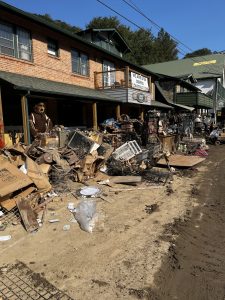
When Hurricane Helene hit Western North Carolina, people expected flooding. What happened in Chimney Rock Village was something else entirely.
The rain was heavy the evening the storm arrived, but not alarming. J. Meliski, a Senior Project Manager at McGill, spent that evening clearing gutters at his family’s two businesses along Main Street in Chimney Rock Village. He went home soaked, but unconcerned.
Overnight, the rain picked up and heavy winds knocked down trees, raising the Rocky Broad River’s water level and triggering mudslides. By morning, the river had jumped its banks and was running through the Village. Usually well outside the floodplain, Main Street was under nearly eight feet of water.
Meliski has deep roots in Chimney Rock Village. He grew up there, and his parents still live in the community. His mother served as mayor and mayor pro tem, and his father was the fire chief for more than 30 years. His family’s businesses — part of the Village for generations — were submerged in river water, then buried in mud. Meliski had plenty to worry about and do to take care of his employees, family, and businesses. Instead, he did what he could to help them, then stepped onto Main Street to start locating water lines.
In the days, weeks, and months that followed, the path to recovery wasn’t a clean line from damage to repair. It was a process defined by a struggle for access and constant unknowns.
More Than Flooding
The damage to the Village and surrounding community wasn’t only caused by rising water: it was driven by force.
Debris in the river built up behind bridges and boulders, creating temporary dams. When those failed, they sent surges of water, mud, trees, boulders, and anything else the moving mass could pick up, downstream. “Everything was fine until one bridge exploded. It would create a dam. And then the second one — every time it just got more and more volume of debris behind it,” Meliski said. “There’s no way you could have accounted for that.”
By the time the surges reached Chimney Rock Village, the volume and velocity were unstoppable.
Sewer lines ran along the riverbanks to connect the Village to the Lake Lure Wastewater Treatment Plant (WWTP). Those lines were wiped out. The waterlines, which were not in the floodplain, failed when sections of the line were washed away. Road banks washed out, and roads that had been in place since the 1920s disappeared overnight.
This wasn’t a case of lack of preparation or under-designed systems. It was an event that exceeded what the systems were designed to withstand. As Meliski put it, “No one expected this. This was a once-in-a-millennia type event.”
Stabilizing First: Getting Water Back
In the first days after the storm, there was no power, no communication, and no clear way into the Village. Roads were blocked. Bridges were impassable. Cell service was nearly nonexistent, and the internet was down.
The immediate priority wasn’t rebuilding — it was restoring water.
“My first thing was trying to find any remnant of the water system that was still in place where we could at least provide drinking water,” Meliski said.
With generators, volunteers, and patchworked infrastructure, the team began bringing the system back online. Progress was uneven. “We thought we were making progress, but then the tank wouldn’t stay full. There’s water just free flowing into the river. We had to go find that and cut that off,” Meliski said.
After roughly two weeks, the system stabilized enough to provide drinking water, which marked one of the first turning points in the recovery. It wasn’t efficient or permanent, but it was enough to allow some residents to begin heading home.
The Reality of Recovery Funding
From the outside, disaster recovery often looks like a funding problem: secure the money and fix the damage. In reality, it is never that simple.
In a stroke of luck, the Village had secured approximately $7 million in state funding to rehabilitate its water and sewer systems prior to Helene. “We had a $7 million project to rehab the water and sewer, and we were ready to put that out for bid [for construction],” Meliski said. After Helene, the funding was no longer for long-term improvements — now it was the starting point for immediate recovery.
McGill worked with the Army Corps of Engineers (ACOE) to quickly get a temporary WWTP packaged plant delivered and installed. Between September and May, the Village was without a working sewer system. Only residents on septic tanks could return home, which were few thanks to the mountainous terrain. Businesses remained closed until the sewer system could be restored. With the new WWTP online, locals could return to their lives.
The $7 million was a jumpstart that allowed progress to begin quickly, but more funding would be needed. For public infrastructure, programs like FEMA provide critical support for rebuilding roads, utilities, and public systems.
For private property, the reality is very different. “As a business owner, FEMA could do nothing for me,” Meliski said. “I had to go through the Small Business Administration and take out a loan.” Many homes and businesses in the Village were not in designated floodplains and did not carry flood insurance. Damage claims were denied. Business owners turned to loans, while homeowners received limited direct assistance, often far short of what full recovery would require.
Privately owned bridges, roads, and access points — common in mountain communities — are not eligible for public funding. “DOT cannot rebuild a private bridge, and no one really knows a good answer or way to pay for that,” Meliski explained. Today, many homeowners are still without access to their homes, and without bridges to cross the river, utilities cannot be restored either.
Even when funding exists, it does not translate into immediate action. As the community can attest, funding comes with requirements, documentation, and timelines that can take months or years to navigate.
The Constraint That Shapes Everything: The Road
If there is a single factor that defines Chimney Rock’s recovery, it is the road: U.S. 64/74. It runs from Asheville to Rutherfordton, serving as both Main Street and the only true conduit through the Village. It was built in the 1920s using technology available at the time: grading on packed earth without much additional structure, even along steep riverbanks and inclines. The banks, roadways, and hillsides were not engineered for the level of force the river and mudslides delivered.
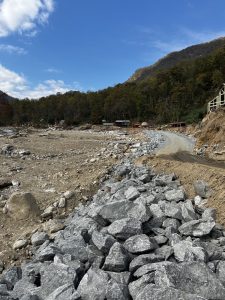
The velocity of the river surges blew out the river channel, leaving behind an undefined gash in the earth. “During the storm, the river moved. It was something like 300 feet wide. You couldn’t even recognize the place,” Meliski said. “So, to get access back, DOT basically moved the river [again] and made it work so you could have a temporary road.”
Currently, the road is under design and construction by NCDOT. Access has been restored, but much of the system remains temporary. Bridges are makeshift, solutions designed with necessity in mind. Portions of the roadway narrow to a single lane. In some areas, both the road and river are still in flux.
Until the road is fully designed and rebuilt, other work, like the stream restoration, Main Street restoration, and beautification projects can only go so far.
Rebuilding Differently
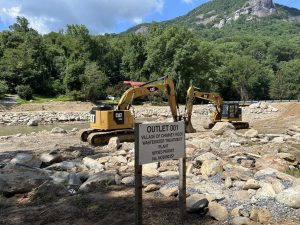
As Meliski noted, this kind of event was unfathomable. Even so, the Village had already begun taking steps to reduce risk — like securing the $7
million in funding to relocate and rehabilitate portions of its water and sewer infrastructure. That groundwork shaped the path forward. In rebuilding, the focus has been on reducing vulnerability where it matters most.
One of the most significant shifts has been in how infrastructure is placed. Sewer lines that once ran along the river and were exposed during flooding are now being relocated into the roadway. “We put the sewer in the middle of the road. Out of the floodplain, out of the floodway. That’s as safe as it’s ever going to be,” Meliski said.
Temporary systems, like the packaged wastewater treatment plant, were brought online quickly to restore basic function. But they are not a permanent solution. “The WWTP is only 15,000 gallons per day (GPD). Long term we need much more than that — closer to 100,000 GPD,” Meliski said.
Those decisions are not always straightforward. “There’s still a lot of unknowns, and you’re trying to navigate different pitfalls throughout the whole process,” Meliski said. Each option carries tradeoffs in cost, complexity, and long-term resilience. Overall, the approach has remained consistent: prioritize function first, then improve resilience where possible.
Where Things Stand Today
Today, a little over 1.5 years later, Chimney Rock Village is no longer in crisis, but it also has not fully recovered. “People are hopeful. We’re starting to see a path forward and things take shape,” Meliski said.
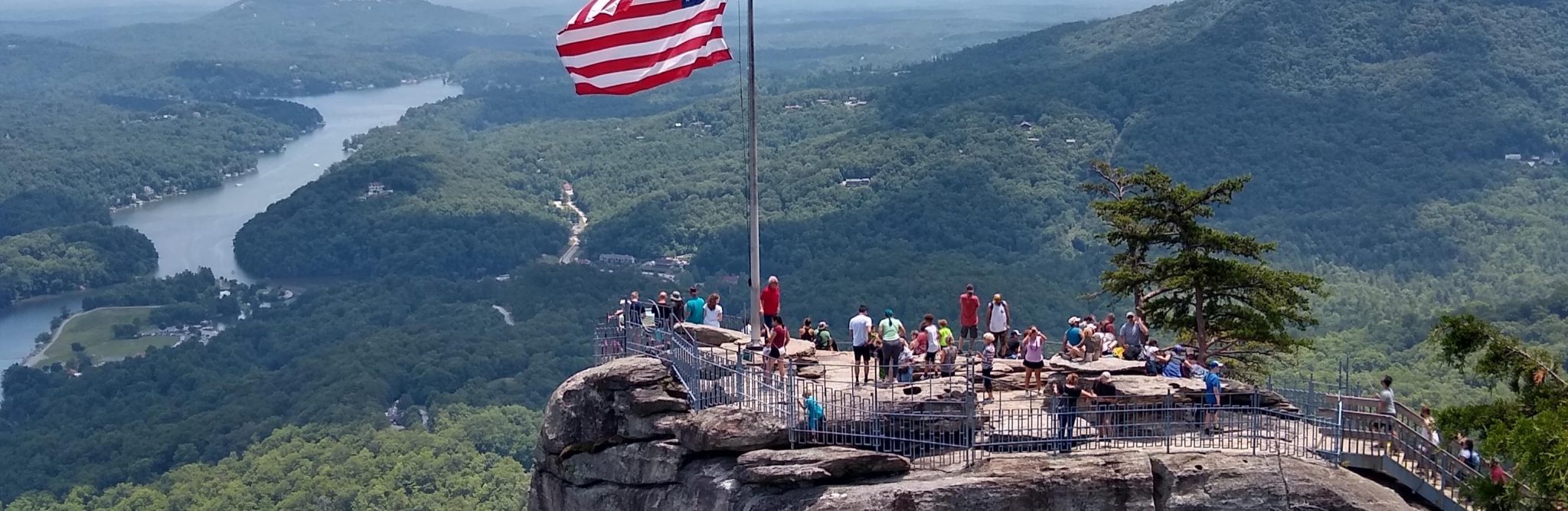
Most businesses that remained structurally intact have reopened. Water and sewer service has been restored to much of the Village. Tourism is returning, and the nearby state park, Chimney Rock State Park, is operational again after the entrance bridge was replaced.
But much of the system remains temporary. The road is not complete. Some private properties remain inaccessible, and with that inaccessibility, utilities remain to be restored. Entire buildings, and the land they once stood on, are gone. In some areas, even the path of the river is still being determined.
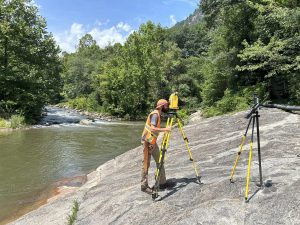
The Rocky Broad River plays a central role in Chimney Rock. It shapes the landscape and draws visitors to the Village. But before it can fully serve that role again, it must be stabilized, and that work hasn’t started yet. “Once the road’s back and we know where everything is, then the riverbanks can be planted—riprap or natural vegetation—and start to heal back into its permanent place,” Meliski said.
Funding has been secured through FEMA and several state sources to continue restoring critical infrastructure, including water and sewer, and to begin rebuilding the downtown. The downtown restoration will rebuild the public-facing elements of Main Street (sidewalks, drainage, and public spaces) that make the Village accessible, functional, and welcoming. This project will bring back the charm and character the Village is known for.
What “Recovered” Will Actually Mean
Full recovery in Chimney Rock Village will not be a return to the past — it will be a gradual transition into something new.
Over the next several years, efforts will focus on:
- Rebuilding the roadway and stabilizing the river corridor
- Restoring access to previously disconnected properties
- Reestablishing permanent utility systems
- Supporting redevelopment where structures were lost
When Chimney Rock is restored, it will feel like itself again. Riverbanks will be stabilized and replanted, bringing the landscape back over time. Volunteers will likely lend a hand, just as they always have.
That spirit is reflected in the planned return of the Flowering Bridge. Once a former roadway, it was transformed into a public garden and became one of the Village’s most recognizable landmarks. It was lost in Hurricane Helene, and it is planned to be rebuilt as part of the Village’s recovery.
Longer term, there is an opportunity to build back with improvements the community wants. Located in a river gorge, the Village attracts outdoors enthusiasts from many different interests. “There’s all kinds of talks with climbing, biking, and kayaking groups and interest in a greenway or hiking path from Chimney Rock to Bat Cave that could tie into the state trail system,” Meliski said. “We want to add river access points to make it more accessible for kayakers and canoeists, too.”
Stepping back, progress is already visible. “There’s a tremendous amount of progress being made,” Meliski said — even if the shape of recovery is still taking form. As recovery work adds up, the Village is slowly beginning to resemble the place it once was.
About McGill
McGill is honored to work with Chimney Rock through these recovery efforts, and we are excited to see how the repairs restore a beloved community in Western North Carolina. To learn more about our disaster recovery work, please visit our website.
There are many resources government officials can use for ongoing mitigation, here are a few: International City/County Management Association (ICMA), FEMA Disaster Recovery Guide, FEMA Courses via the Emergency Management Institute, and the North Carolina Division of Emergency Management.