From Graduate Research to Industry Resource: Turning Sediment Basin Design into a Practical Tool
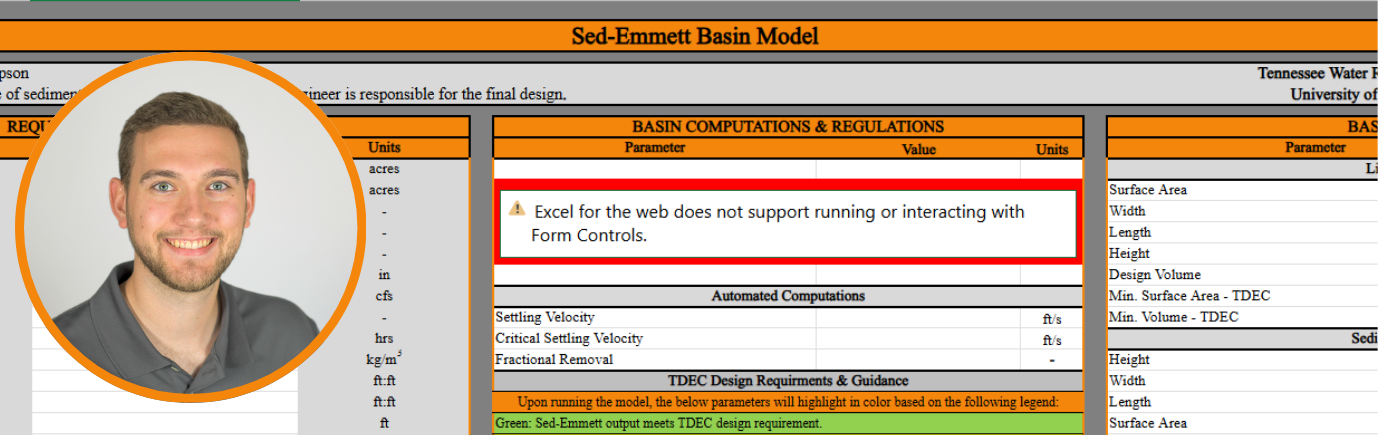
What began as a graduate school research project has become a practical design tool for engineers across Tennessee. Through collaboration and a commitment to solving a real-world engineering challenge, McGill Project Engineer Cole Emmett recently achieved a long-term goal with the publication of the Sed-Emmett Sediment Basin Design Model through the Tennessee Water Resources Research Center at the University of Tennessee.
The model helps engineers’ size and design sediment basins based on project-specific site characteristics while generating design drawings that comply with Tennessee Department of Environment and Conservation (TDEC) standards. By replacing generalized "go-by" designs with site-specific calculations and innovative inputs like particle size distribution and target treatment size, the tool improves design accuracy, consistency, and efficiency.
Solving a Design Challenge
The idea originated while Cole was pursuing graduate studies, when the Tennessee Department of Transportation (TDOT) identified an opportunity to improve sediment basin design practices. At the time, TDOT and TDEC each had different design standards for sediment basins.
"My thesis focused on comparing the two sets of standards, understanding why they were different, and developing a better approach that blended the strengths of both," Cole explained.
As part of the research, he conducted physical modeling studies using small-scale sediment basins, collecting data that became the foundation for the design model. The result was a tool capable of optimizing basin configurations by using drainage area, disturbed acreage, development conditions, dewatering methodology, and particle size distribution capable of removing a pre-specified sediment load. While the model was developed around Tennessee's design requirements, much of the methodology can be adapted to other states by modifying the regulatory criteria.
A Project Years in the Making - Sed-Emmett Sediment Basin Design Model
The work began in 2021 as part of a master's thesis funded by TDOT. After graduating in 2022, the project was handed off to a research assistant at the Tennessee Water Resources Research Center, who continued refining the model over the next two and a half years. Throughout the process, Cole remained actively involved, working alongside the research team to improve functionality and address technical issues.
One of the biggest challenges came when TDEC completely modernized its sediment basin design standards during development.
"That required us to go back and revise significant portions of the model," Cole said. "There was a lot of trial and error fixing errors and making sure everything reflected the updated standards."
The continued partnership between TDOT, which funded the original research, and TDEC, which supported the model's refinement, ultimately helped bring the project across the finish line.
Research That Makes a Difference
As adoption grows, Cole hopes the tool will continue to evolve and become a widely used resource. Seeing the model published is especially rewarding because it demonstrates that graduate research can create meaningful, real-world impact.
Cole encourages young engineers and graduate students to stay committed to projects they believe in, even when progress takes longer than expected.
"It took several years after graduate school to see this become reality," he said. "Keep the big picture in mind and remember why you're doing the work. If your research solves a real problem, it's worth seeing it through."
Cole's journey reflects McGill's commitment to investing in the growth and development of its employees. Whether supporting advanced education, encouraging innovative thinking, or providing opportunities to turn ideas into industry resources, McGill empowers employees to expand their expertise and make meaningful contributions to the profession.
Learn more about the Sed-Emmett Sediment Basin Design Model